

The Vibe Coding Wave Is Here: 5 Builders Who Turned Vibe Coding Into Serious Money
These are the builders proving it’s not just hype—it’s a fundamental shift in who gets to build software...


For the past few months, I’ve been combining design sprints with vibe coding as the core of my consulting practice. Every day I’m in Claude Code, building products that would have taken traditional dev teams months to ship. And in between sessions, I’m on X watching other builders document their own journeys—solo founders hitting six figures, non-technical creators launching SaaS products, former traders deploying AI agents.
The pattern is unmistakable. We’re living through a moment where the barriers to building software have collapsed so completely that the only real constraint left is intention. Do you know what problem you’re solving? Can you articulate it clearly enough for an AI to help you build the solution?
If yes, you can build. And these five builders are proving you can build profitably.
I’m not here to sell you courses or hype. I’m here because I’ve spent sixteen years in startups, led teams, raised capital, and watched multiple tech cycles play out. This one’s different. The velocity is unprecedented. The accessibility is real. And the money? It’s following the builders who ship.
Here’s who I’ve been watching, what they’ve built, and what we can learn from their approaches.
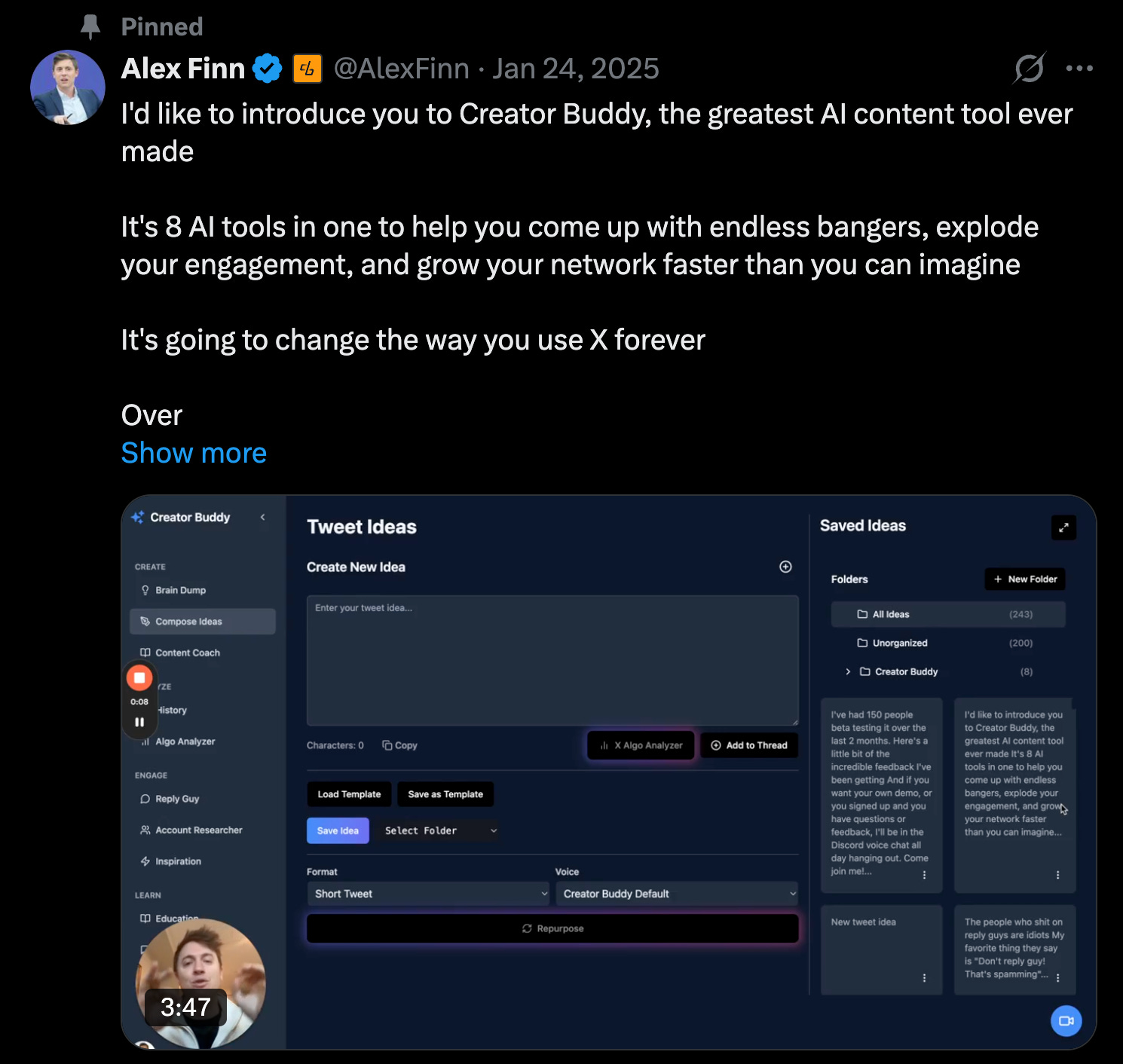
1. Alex Finn – The $300k Solo SaaS Blueprint
The Build: Creator Buddy, an AI tool that analyzes your X posts to generate personalized content
The Numbers: $300k ARR, 90% margins, zero employees
The Timeline: 10 months from first prototype to six-figure revenue
Alex started 2025 as a non-technical founder. By December, he’d built and scaled Creator Buddy entirely through Claude Code—no engineering team, no traditional code, just conversational development with AI.
His approach was methodical: Use Grok to identify audience pain points, generate potential solutions, then feed those into Claude Code to build the actual product. He documented everything publicly, running the numbers in threads: “2,639 hours of vibe coding. $300,000 ARR. 0 lines of code written manually.”
The skeptics came out immediately. “You can’t vibe code serious apps” became a recurring refrain. Alex’s response was to keep shipping and posting revenue screenshots. By early 2026, he’d launched the Vibe Coding Academy and built a 40,000-subscriber AI newsletter as additional revenue streams.
What he’s teaching us: Start small, iterate in public, and turn your learning process into a second revenue stream. His stack is straightforward—NextJS, Vercel, Supabase, Claude—proving you don’t need exotic tools to build profitably. You need clarity on the problem and persistence through the skepticism.
The real insight? Alex monetized his expertise while building his product. He didn’t wait until Creator Buddy hit $300k to start teaching. He documented the journey from day one and created parallel income streams around the knowledge he was accumulating.
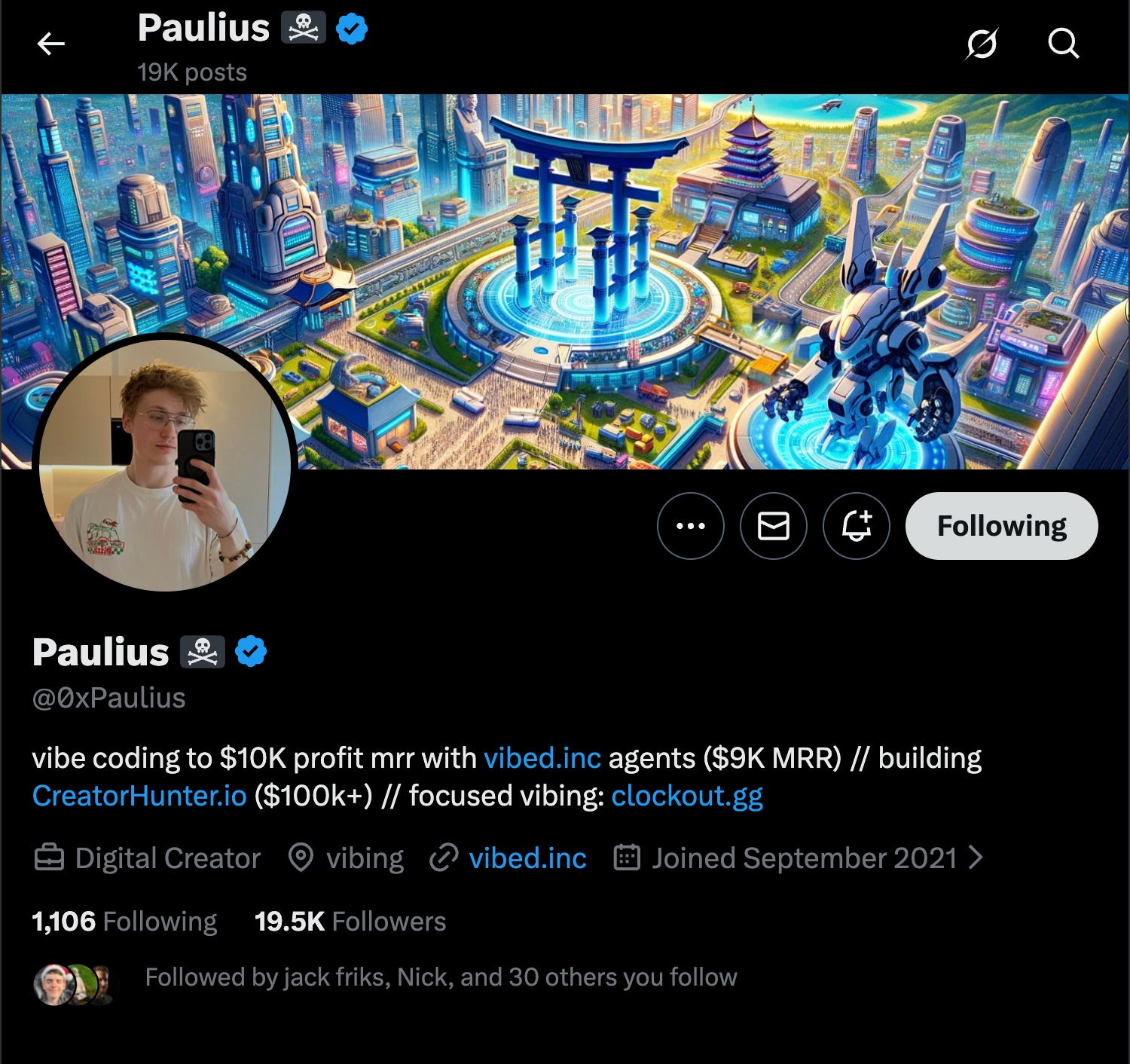
2. Paulius – Scaling AI Agents to $9k MRR
The Build: Vibed Agents, a platform deploying autonomous agents to build apps with Claude Code
The Numbers: $9k MRR, $100k+ total revenue, 30k+ users across 10+ apps
The Timeline: 365 days of daily building in 2025
Paulius (@0xPaulius) is the definition of focused vibing. Nine months before launching his first app, he didn’t know how to git commit. By the end of 2025, he’d shipped 10 applications and built a platform that lets others deploy AI agents to build apps autonomously.
His origin story matters: “This came from my own frustration. Real vibe coding feels like a hidden technique still.” He started with Cluely, a tool for creating full-stack apps the way a real dev would. Then evolved to Vibed Agents when he realized the next layer—agents that build without constant human intervention.
The technical evolution is instructive. In October 2025: “CLAUDE CODE SKILLS + MCP IS LVL 999 VIBE CODING. Never have I felt so unstoppable.” By December, he’d distilled his learning into frameworks he shares freely: “365 days of vibe coding, months of research, sharing all the best Claude Code cheats.”
What he’s teaching us: Fix the pain points in your own workflow, then productize the solution. Paulius didn’t start by trying to build for everyone. He built tools that solved his immediate frustrations as a solo builder. Then he scaled those tools into platforms others could use.
His evangelism for unlimited tokens is worth noting: “$100 for unlimited tokens is the way. Vibe coding is pure gambling if you’re using anything that requires AI credits.” It’s a philosophical stance as much as practical advice—when your entire workflow depends on AI, you can’t afford to be rate-limited.
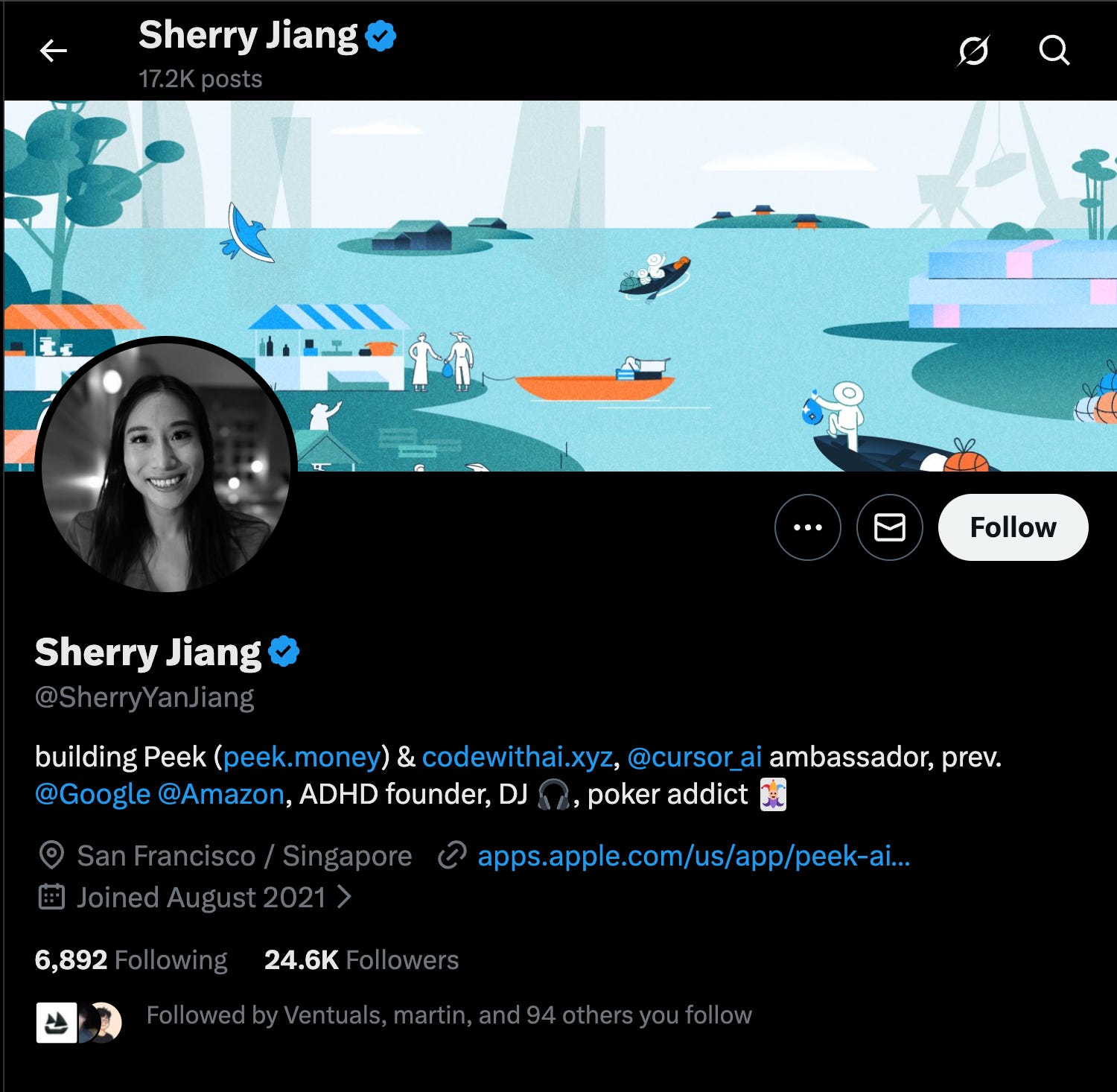
3. Sherry Jiang – Prototyping to $275k Funding in 3 Hours
The Build: Peek.money, a fintech tool for instant financial insights
The Numbers: $275k from accelerator funding
The Timeline: 3 hours from idea to fundable prototype
Sherry’s story bridges the technical and non-technical worlds. Former Google and Amazon engineer, now founder and Cursor ambassador. In May 2025, she vibe-coded the first version of Peek.money in a single afternoon and used it to secure accelerator funding.
Her stack for that initial build: ChatGPT for product requirements, v0 for UI, Cursor with Claude for integrations, Supabase for backend, Vercel for deployment. Three hours, five tools, quarter-million in funding.
But Sherry’s real contribution isn’t just speed—it’s education. By September: “What blows my mind about vibe coding: normal people go from ‘I can’t code’ to ‘I just built an app’ in an hour.” She started running workshops, corporate training sessions, and launched Code with AI to teach non-technical builders.
Her framing is direct: “Excel was the literacy of the 90s. Vibe coding is the literacy of the 2020s.” And her comparison of traditional dev costs is brutal: “Saw a dev shop quote a friend 60 days and $20k+ to prototype an AI dating app—that could literally be vibe coded in an afternoon in Cursor.”
What she’s teaching us: Speed is a competitive advantage, but teaching multiplies your impact. Sherry could have kept building products. Instead, she built a movement. Her former students now run their own vibe coding events, creating ripple effects that extend far beyond her direct reach.
The lesson here is about leverage. One person building products has linear impact. One person teaching thousands to build has exponential impact—and multiple revenue streams.
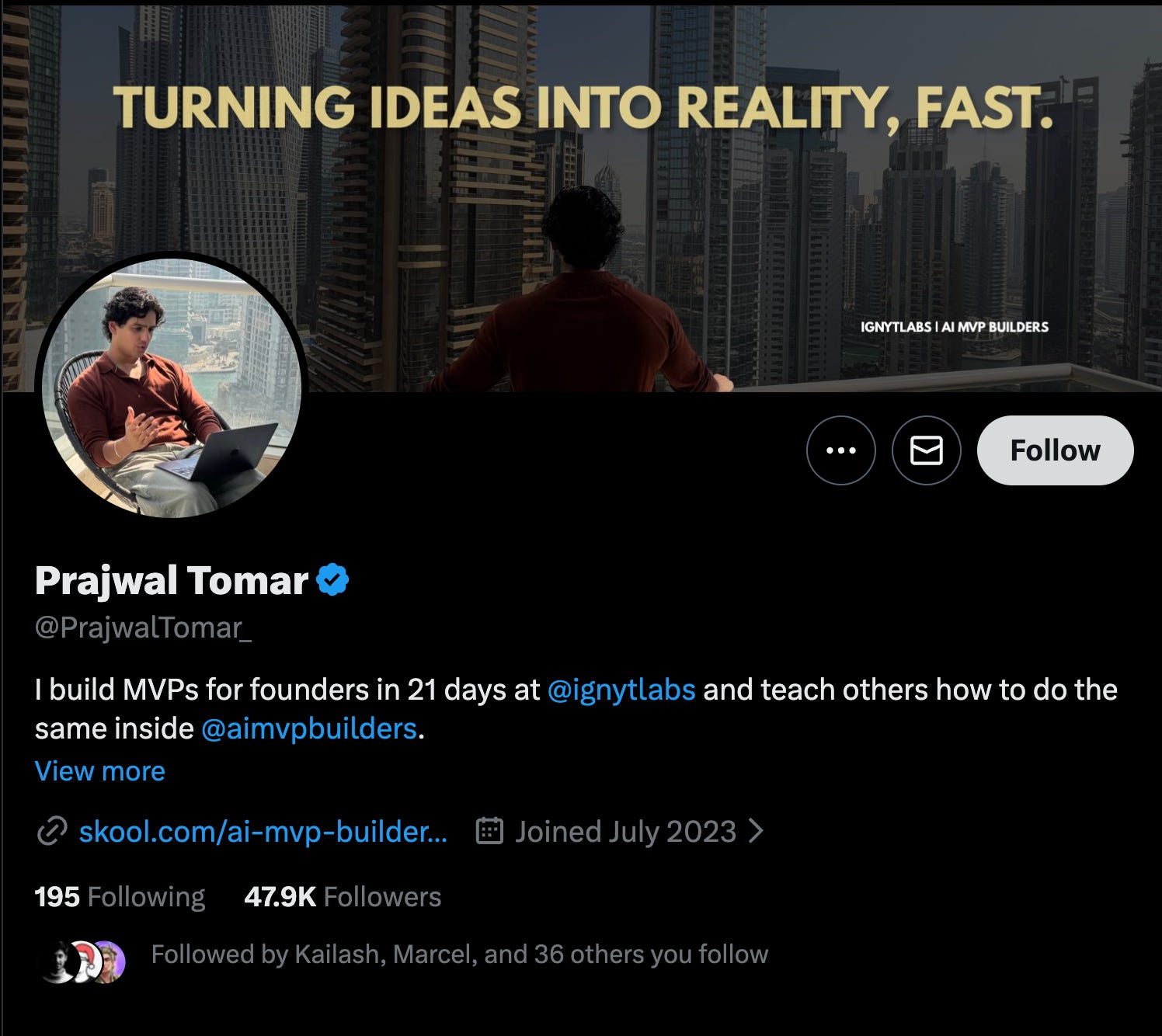
4. Prajwal Tomar – The 21-Day MVP System
The Build: AI MVP Builders, a structured system for shipping products in 21 days
The Numbers: 45+ MVPs shipped for clients through Ignyt Labs
The Stack: Dribbble for design inspiration, Lovable for quick prototypes, Cursor + Claude Code for development, CodeRabbit for review
Prajwal turned vibe coding into a repeatable consulting system. While others were experimenting, he was building structure. His “loop” workflow treats Claude Code like a senior intern: Load context, iterate features, review before shipping, use CodeRabbit for quality checks.
His frustration with sloppy vibe coding is palpable: “I don’t understand how people can be so shitty at vibe coding. We build SaaS for our clients almost daily. Guide it like you would a super smart intern.” He’s not gatekeeping—he’s pushing for craft.
By December 2025: “Vibe coding didn’t take over because it’s ‘better than traditional engineering.’ It took over because it removed excuses.” His emphasis on security is notable: “You can build a fully secure app even with vibe coding if you do it properly.”
What he’s teaching us: Structure beats chaos. Prajwal’s success comes from treating AI-assisted development as a discipline, not a magic trick. He’s built a system that’s teachable, repeatable, and scalable. His agency doesn’t just ship one-off projects—it trains founders to ship their own MVPs using his framework.
The broader insight: Vibe coding isn’t about replacing engineering discipline. It’s about making that discipline accessible to people who previously couldn’t participate. But you still need process. You still need review. You still need to understand what you’re shipping.
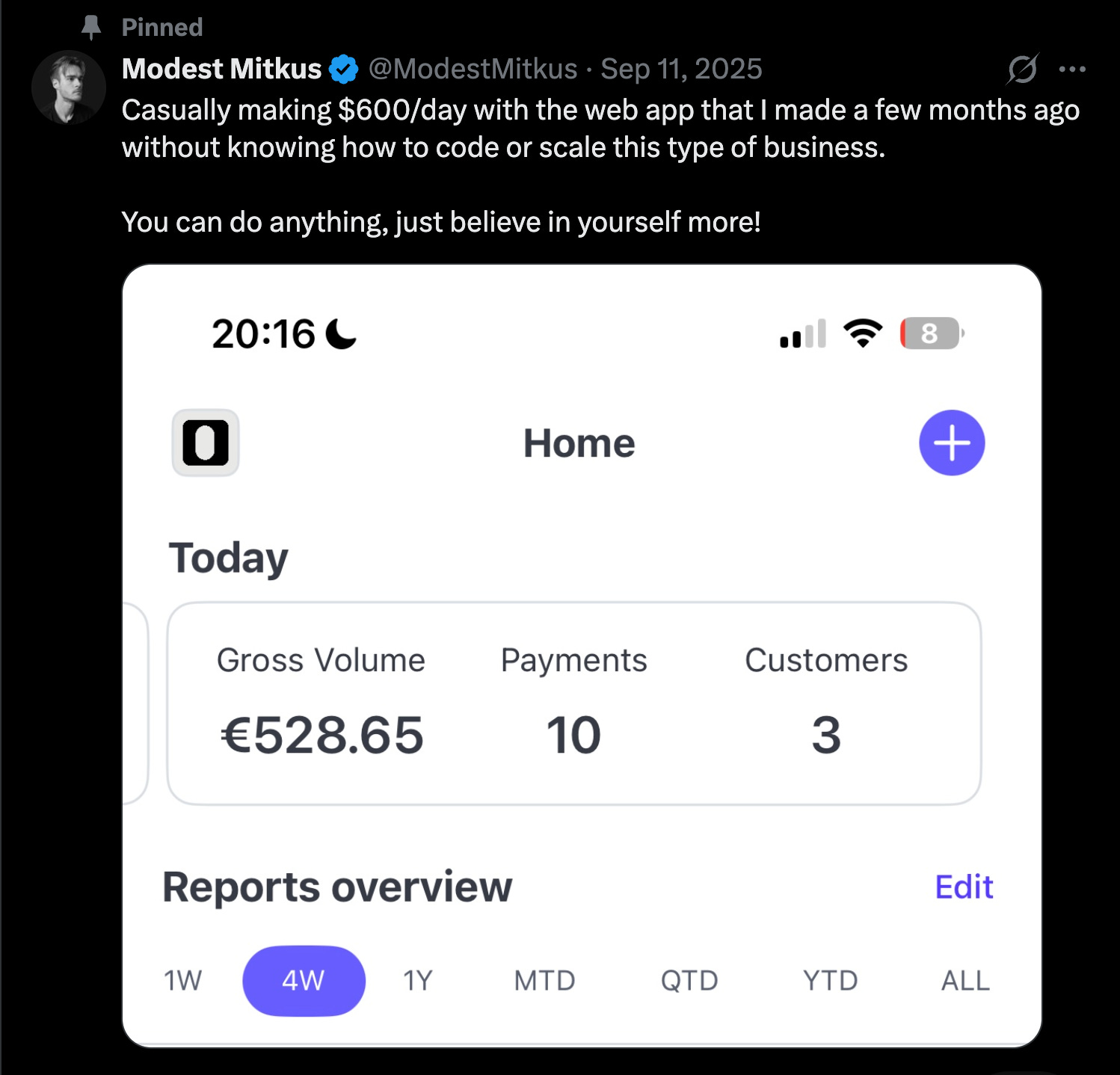
5. Modest Mitkus – The Zero-to-$23k MRR Non-Coder
The Build: First-ever SaaS built without coding experience
The Numbers: +$23k MRR growth in a single month, $500k/year across multiple digital products
The Timeline: From complete novice to explosive monthly recurring revenue
Modest Mitkus (@ModestMitkus) represents the purest form of the vibe coding promise: someone with zero coding experience building software that generates serious monthly revenue.
In October 2025, he posted the numbers that make vibe coding skeptics pause: “My vibe coded app grew by +$23,000/month MRR this month. It was my first-ever SaaS that I built without knowing how to code. Vibe coding literally changed my life.”
This isn’t a developer pivoting to new tools. This is someone who previously couldn’t participate in software building at all, suddenly able to ship products that scale. His portfolio now includes multiple digital products generating $500k annually, with vibe coding as the catalyst for all of it.
What he’s teaching us: The “learn to code first” barrier is actually gone. Not metaphorically. It’s nonexistent. Modest didn’t spend months in bootcamps or years building technical fundamentals. He went straight from idea to shipped product using conversational AI development.
If someone with zero coding background can hit $23k in monthly recurring revenue on their first SaaS, we’re not talking about a marginal improvement in productivity. We’re talking about an entirely new population of builders entering the market.
Modest’s positioning himself as proof that the accessibility is real—not just for technical founders learning new tools, but for complete beginners identifying problems and building solutions from scratch. The question isn’t whether you can code. It’s whether you can articulate the problem clearly enough for AI to help you solve it.
What This Actually Means
I’m not sharing these stories to convince you that vibe coding is easy money. It’s not. Alex spent over 2k hours building. Paulius shipped every single day for 365 days. Sherry’s running corporate workshops alongside product development and has worked at big tech companies. Prajwal’s built an entire consulting practice around structured workflows and has years of experience.
The pattern I’m seeing: The builders making money aren’t just using AI tools—they’re developing systems, teaching their methods, and building in public.
None of them are hiding their process. They’re sharing workflows, posting about failures, documenting what works. And that transparency is creating secondary and tertiary revenue streams beyond the products themselves.
The real shift isn’t just that non-technical people can build software now. It’s that the entire product development cycle has compressed so dramatically that the traditional separation between building, teaching, and selling has collapsed. You can do all three simultaneously.
Which brings me back to why I’m tracking this so closely: The barriers to building are gone. What’s left is intention.
If you’ve been waiting for permission to start building, this is it. The tools are here. The examples are documented. The money is real. What’s missing is just the decision to begin.
I’ll be sharing more about my own building process, the workflows I’m developing, and the patterns I’m seeing emerge as this revolution continues. But these five builders have already proven the model works.
The question now is: What are you going to build with it?
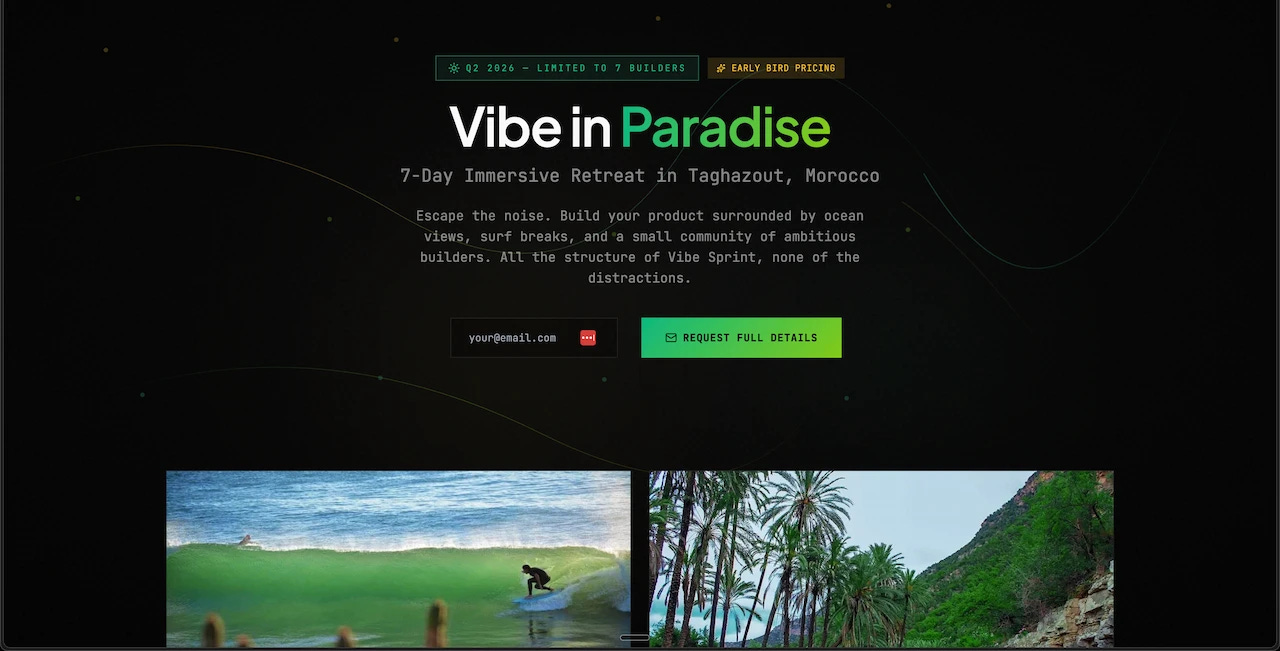
P.S. — Check out the 14-day Intro to Vibe Coding journey on Vibrana.ai as well as the upcoming course Vibe Sprint Academy where I share everything I learned from my 16-year startup journey. Join us for Vibe in Paradise if you want to learn how to vibe code with friends while surfing in Morocco, eating amazing food and exploring the indigenous culture of North Africa.
—-
If you’re building something—or thinking about starting—I’d genuinely love to hear about it. Drop a comment and let me know what you’re working on. And if this resonated, subscribe to follow along as I continue documenting what I’m learning in the trenches.